FH Trackers

FH®
Trackers

All healthcare is local. Disease prevalence and healthcare procedures and costs vary with geography. FAIR Health can shine a spotlight on the location you want to study and the information you need. We can provide customized data analyses and visualizations on the level of a geozip (a geographic region typically defined by the first three digits of a zip code), a combination of geozips, a state, a multistate region or the nation. The questions we can answer include:

  • What states have the most private insurance claims for a condition?
  • How has utilization for the condition changed over time?
  • What age and gender groups are most likely to be diagnosed?
  • What are the most common and costly procedures for the condition?

All healthcare stakeholders benefit from this geographic window into the data, including federal and state governments, policy makers, researchers, patient advocacy groups, regional associations, payers, providers and manufacturers. For more information on how analyses and visualizations can be customized to your particular needs, see Custom Solutions.


Monthly Telehealth Regional Tracker

Monthly Telehealth Regional Tracker

The Monthly Telehealth Regional Tracker uses FAIR Health commercial data to track how telehealth is evolving on a monthly basis. An interactive map of the four US census regions allows the user to view an infographic on telehealth in a specific month in each region, or in the nation as a whole.

For January 2024, each infographic shows telehealth’s percentage of medical claim lines; for subsequent months, changes from month to month in that percentage are shown. Throughout the year, each infographic presents the top five telehealth diagnostic categories, top five mental health telehealth diagnoses and top five telehealth specialties. Also included is the age distribution for telehealth and the Place of Service Cost Corner, which compares median allowed amounts for a specific procedure provided via telehealth to the same procedure provided in an office.

For 2024, all charts in the infographics are based on claim lines, but beginning in January 2025, most of the charts are based on commercially insured patients with a telehealth claim. These include top five diagnostic categories; top five procedure categories; urban versus rural telehealth usage; age distribution; and percent of patients with a telehealth claim. One chart continues to show telehealth’s percentage of medical claim lines.

See the Map
Monthly Telehealth Regional Tracker

Opioid Tracker

Opioid Tracker

Opioid Tracker

Opioid Tracker

The heat map in this section represents patients with opioid use disorder diagnoses per 100,000 commercially insured patients receiving medical services in 2024 for each state. Clicking on a state displays an infographic for that state with opioid use disorder data from 2024. The infographic includes the top five procedure code categories by utilization, the top five procedure codes by aggregate allowed amounts, the change in the number of patients with opioid use disorder diagnoses per 100,000 patients from 2021 to 2024, and the distribution of patients by age and gender. There is also a similar infographic for the nation as a whole, along with a second national infographic showing the top five states for opioid use disorder, the fastest-growing specialties, the distribution of places of service, and service type (professional versus facility) as a percentage of total allowed amounts. The source of the data is FAIR Health’s National Private Insurance Claims (FH NPIC®) repository.

See the Map

Cost of Giving Birth Tracker

Cost of Giving Birth Tracker

Cost of Giving Birth Tracker

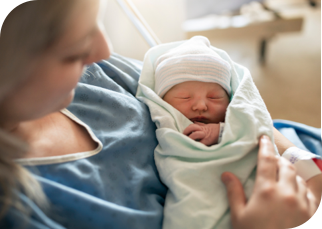
Based on FAIR Health commercial data, the interactive heat maps in this section show state-specific and national median charge and allowed amounts for vaginal deliveries and C-sections. Inpatient and outpatient facility and professional costs are included. Services include the delivery itself (e.g., pharmacy, nursery, labor and delivery room, medical and surgical supplies, room and board for the mother), anesthesia, fetal nonstress tests, ultrasounds, laboratory work and breast pump.

See the Map
Cost of Giving Birth Tracker